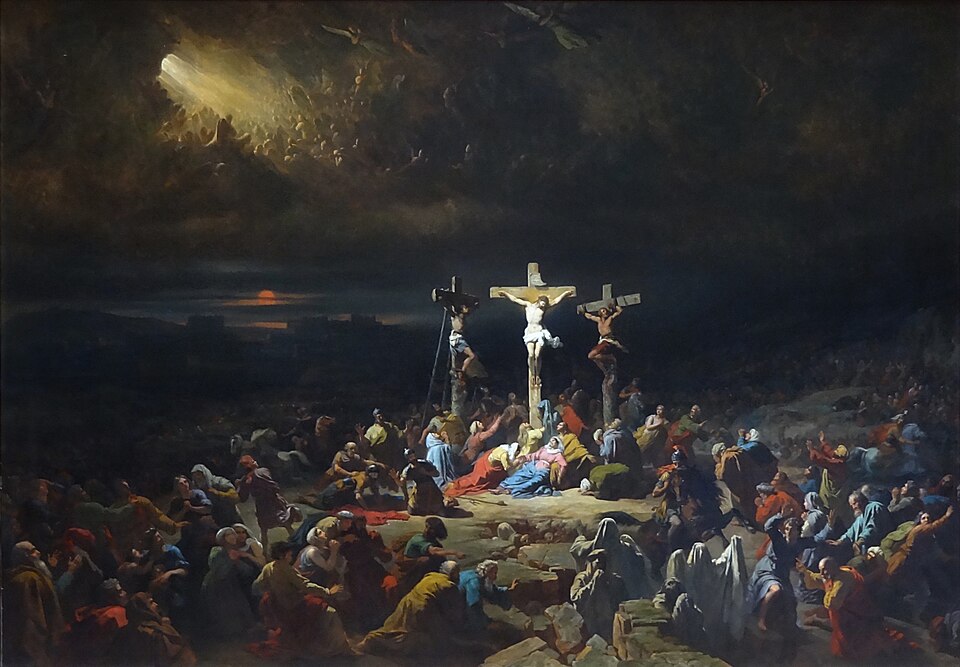
The last moments that Christ spent on Earth are well-documented, with all four Gospel accounts containing Passion narratives, and thus there is a wealth of material for us to meditate on as we reach the most solemn and somber moments of this Holy Week. Traditionally, the Seven Last Words of Christ — a series of His last sayings as recorded in the various Gospels — are used throughout Lent and Holy Week, but especially on Good Friday, as a devotional to promote exactly this kind of introspective meditation. Christ is the supreme example of everything for us: being fully human, He experienced the emotions that we do; having human friends, He experienced betrayal as we might; and understanding the importance of forgiveness, He forgave as we ought to. It would do us well, then, to listen to what He had to say so many years ago when He experienced the most ignominious death known to mankind, understanding that our humanity is only advanced and bolstered when we embrace Him while the world denies Him.
“For when the hour had come for Him to be glorified by you, Father most holy, having loved His own who were in the world, He loved them to the end: and while they were at supper, He took bread, blessed and broke it, and gave it to his disciples.”[1] This simple Institution Narrative provides us with a wealth of insight into Jesus’ mindset on the night of Holy Thursday, short as it may be. We know from the Gospels that Jesus had rented the upper room of a house in Jerusalem from an unnamed man, and that He intended to eat the Passover meal with His apostles in the same room before He proceeded with His sacrifice, the greatest gift known to human history.[2] How humble of an action even this was, however, because Jesus does not demand that He be allowed to use this spacious room for His final Passover, nor does He coerce the owner into allowing Him use of the space. Rather, the apostles are specifically told to ask the man if they would be able to rent the room for the evening, and only if he agrees are they to begin to make preparations for the festal dinner. Even the dinner itself is a fascinating thing to reflect on, because Christ — having the divine foreknowledge of what was going to occur during His Passion — still chose to celebrate the Passover joyfully with His disciples before moving into the more somber activities of the later evening with only a few chosen companions. When faced with the most suffering that any human could ever face, Our Lord still chose to be joyful for a spell before facing the other emotions that awaited Him. How useful it would be for us to learn to embrace this same joy within sadness!
Having suffered the excruciating pain of sweating blood in the Garden of Gethsemane, and having accepted the weight of what He was about to do in order to fulfill God’s plan of salvation, Jesus finds Himself being betrayed by one of the Twelve — the first action which triggers this first saying. Although Jesus knew who His betrayer was in His divinity[3] (and was thus not surprised when Judas appeared with the temple guards “as against a robber, with clubs and swords”),[4] it is not impossible to believe that — in His humanity — He was wounded by this blatant act of betrayal by one of His closest friends. After all, being fully human just as He was fully divine, Our Lord experienced human emotions just as we do. We would say that He was entirely justified in feeling as He did, not least because our culture condones holding grudges against those that seriously hurt us. And yet, He accepted this with the utmost humility. Thus, the first betrayal.
The second would ultimately come from a whole host of people. The Sanhedrin, the crowd of Jews in the courtyard of the praetorium, Pontius Pilate, and the centurions all deny Christ, although they have all been told that He is the Messiah, and the rightful King of Israel (in a religious sense, because His kingdom “is not of this world”).[5] Through their actions, however, and their explicit denials in some cases, they reject Him, preferring His death to any other form of continued coexistence. The members of the Sanhedrin had taught alongside Jesus in the temple, and as He pointed out, they never did anything before He was sequestered on Holy Thursday night.[6] Among the members of the crowd would likely have been citizens of Jerusalem that had just a few days earlier welcomed Him into the city with joy shouting, “‘Hosanna! Blessed is he who comes in the name of the Lord! Blessed is the king of Israel!’”[7]
The third betrayal would have been from Our Lord’s own apostles, who fled from the soldiers when He was arrested.[8] They could not stand to admit that they were scared, and so they betrayed Him — He who loved them unto the end despite their shortcomings — by running away. The fourth betrayal of Jesus? That would be ourselves. Our actions as sinful human beings — and especially the actions of our first parents, Adam and Eve, that led to the necessity of salvation in the first place — are the reason that He did what He had to do. Every time that we sin, we are betraying Our Lord in our hearts. And how did He respond to all of this betrayal? He forgave them, and He forgave us. He faced more betrayal in one day than just about any human will face in their entire life, and He continues to face betrayal today. And yet, through it all, He simply forgave all of those who made His life difficult. Not only did He forgive them, however, but He also asked His Father in Heaven to forgive them, because of their ignorance and the necessity of His task. There’s a lesson in there for us. It is so easy to refuse to forgive those that have hurt us, for this, that, and the other reason. But if Our Lord was able to forgive every single person that contributed — and continues to contribute — to His death when He was hanging upon the cross, then who are we to refuse to forgive? Perhaps it was difficult (in His humanity) for Jesus to forgive those who wronged Him, as He understood the human emotion of betrayal well, but He was still able to forgive. If He could, then we most certainly can, too.
These words, delivered by Our Lord to the Good Thief that was crucified alongside Him, are among the most promising that He uttered on the cross. At first glance, there is not much of a lesson to be had here. After all, we cannot promise people a spot in Paradise. However, there is something to meditate on in the promises that Christ made. This thief, who tradition names St. Dismas, was crucified for something that he admits that he is guilty of. He acknowledges such, telling the thief that is ridiculing Christ that they have been “condemned justly,” but recognizes that Jesus had “done nothing criminal.” After this, he begs Jesus to “remember [him] when [He] comes into [His] Kingdom.”[9] Upon hearing this, Our Lord is moved and promises him that he will end the day in Paradise, which would seemingly be undeserved given his status as a criminal. However, as with His first saying, Christ has compassion on those who are so undeserving of His mercy. Just as He had asked His Father for forgiveness for those that had betrayed Him, He now promises a spot in Paradise to the repentant sinner being crucified alongside Him. It is a fundamental belief within Catholicism that those that are repentant and show their repentance in the Sacrament of Reconciliation will once again see the face of God, because His mercy is infinite. Just as St. Dismas was repentant, so must we be. But it is our sincere belief that with honest and truthful reconciliation comes our own promise that we will one day be with the Lord in Paradise.
St. John recounts in his Gospel that these words were spoken to him and Mary, the Mother of God, at the foot of the cross. Jesus, by now being almost dead, told His Mother that she should go to live with St. John, and that St. John should look after her, “and from that hour the disciple took her into his home.” The third of seven of Christ’s last words is both literal and figurative, and both are rich with symbolism. That Our Lord would entrust His Blessed Mother to St. John, who is elsewhere referred to as His beloved,[10] shows just how strong their bond is. Traditionally, it would be the responsibility of the eldest son to take their mother in when their father passed away, and likewise of the next heir if the eldest son were to predecease their mother. As Jesus had no siblings, He could not ask His brother to watch over her as she deserved, so He instead entrusted her to St. John, the one apostle that did not run away from Jesus when He was being crucified. St. John was there the entire time along with the Blessed Virgin Mary, a steadfast witness to their faith and willingness to stay with Jesus.
Figuratively, the Church has long read this passage as an entrustment of the entire Church to the Blessed Virgin, such that it is the basis for devotion to — and intercession requests of — her. Likewise, she is entrusted to us, so that we may protect her reputation and respect her queenly authority as the Mother of God who is seated at the Right Hand of her Son. But if the Church is entrusted to Mary, then we are meant to live under her mantle, united even more with Christ than we could be if we were apart from her. She keeps watch over us, as Jesus commanded, and in return, we honor her as is worthy of her exalted place. Thus, we are to behold Our Mother, who in turn beheld her Son as He hung on the cross, breathing His last breaths. The pain that she experienced within her Immaculate Heart must have been unbearable, but we are to look to her for a reason: Mary got through the Crucifixion and Death of her Son with steely resolve, believing in His Resurrection as He had promised. Through Mary, we gaze upon Christ, and thus we should share in her hope. For just as she believed in His Resurrection that came to pass, so, too, should we believe in the Second Coming with our whole hearts, so that we may be united both with Our Mother and with Our Savior.
My God, my God, why have you forsaken me?
This citation of Psalm 22, uttered by Our Lord as He fast approached His final moments, fulfills the Scriptural prophecy that the Messiah will seem forsaken by God. Ironically, it would seem that this was lost on the bystanders, who — unless they were not Jewish — should have known the Scriptures; and yet, when He said this, they thought that He was calling for Elijah the Prophet to take Him down from the cross. Regardless, He was not summoning Elijah, but was rather speaking with His Father, asking God why it seemed that He was being abandoned. And it isn’t impossible to see why the Lord may have seemingly been abandoned. After all, He was dying on a tree, although He could have summoned “no less than twelve legions of angels” to save Him if His Father so desired.[11] However, Our Lord was not abandoned, nor was He forsaken. Instead, He had willingly submitted to this brutal and humiliating death so that our sins would be forgiven in the manner laid out and desired by His Father.
Similarly with us, there are moments in our lives in which we feel that we may have been abandoned or forsaken by the Lord. It is not impossible to imagine that we are alone when we face extremely difficult challenges. After all, it may appear to us that God is not with us in these dark moments when we feel alone. But just as God did not abandon His Son, so, too, does He accompany us through all of our darkest moments. It is tempting to say that God has forsaken us, and to ask Him why He would do such things. However, this is just that — temptation. We do not have to give in to such things, although the Devil would rejoice with all of his hosts of demons if we did. Rather, like Our Lord, we should be heartened to recall that Our Father is indeed always with us, and that He will never abandon us, even when things seem hopeless. If He could be with His Son during the latter’s Crucifixion, then He is most certainly with us throughout whatever life may throw at us. Nothing can compare to the love of the Father, and likewise nothing can limit it.
In His humanity, Jesus would have suffered all of the pains that were associated with crucifixion, up to and including having a very dry mouth due to the amount of heavy breathing that He would have been doing as He struggled to breathe on the cross. It is natural, then, that He would have requested a drink as He neared His end. It would make sense that He would want to quench His thirst before He handed over His Spirit. We are told by St. Matthew that one of the bystanders “ran to get a sponge[,] soaked it in wine, and putting it on a reed, gave it to Him to drink.”[12] Now, it logically tracks that this wine was the same wine that was offered to Our Lord before He was hung on the cross. It would thus be mixed with gall, which is a natural narcotic made by mixing wormwood and myrrh, and which He refused the first time. It is fascinating to realize, then, that Our Lord was both brought into this world with myrrh, and also that He left it to the same perfumed resin. When the Magi visited, He was gifted a chest full of myrrh,[13] and as He departed from the world, He was once again offered the gift — if it can be called that — of myrrh-infused wine to ease His suffering. In His thirst, Our Lord accepted a drink that brought His life full circle.
Like Our Lord, we often find ourselves thirsting for something, although our thirst usually is not material. Yes, we also experience material thirst, but we are able to quench that fairly easily in the United States. Our spiritual thirst, however, is not so easily resolved. In fact, it can be quite difficult to satisfy it without a full acceptance of Christ. We can tell ourselves that we love the Lord as much as we can, but if we still feel an emptiness and a yearning in our souls — like thirst — then we have not satisfactorily accepted Him into our hearts. Just as Our Lord’s thirst was satisfied with something that He was gifted at His birth, so is ours. When we are baptized, our godparents make a promise on our behalf that we will accept the Lord with our whole hearts and that we will reject Satan and sinful evil. So often, however, we find ourselves caught in the grasp of sin, a sin that we thought we could easily vanquish. When we fully and freely accept the gift of the Lord’s love, however, it becomes much easier to overcome these repeat sins. Of course, none of us are perfect, and we will fail again, but forgiveness is within reach, and with the gift of love, we are able to accept the gift of forgiveness, and so our spiritual thirst can be quenched.
As He slipped from this world into the next, “Jesus cried out in a loud voice, and gave up His spirit.” It was at this moment, we are told, that the Temple’s veil was torn into two pieces, and that an earthquake rocked Jerusalem. The Lord had given His Spirit up to His Father; it was finished. We also know that the disciples that had stayed at the foot of the cross, and Mary, the Lord’s Mother, were distraught. Yes, they had been expecting this, because Our Lord had prepared them for it, but there must be no feeling in this world like watching one’s friend and Son — the Messiah of all mankind — groan and proclaim, “It is finished.” After all that Christ had done, this seems like a most anti-climactic end. Sure, the natural disasters that accompanied it were grand, but the words were so brief, and given so quickly.
It might seem that our deaths will be just as Our Lord’s was. They are quick, God-willing, and of little ceremony. Perhaps we can sense the end as He did, and perhaps we cannot. But at some point, all of us will have our “It is finished” moment in which our souls will be commended to the Lord. We can only hope that we will be welcomed into Heaven for eternity and embraced with joy by Our Lord during the Second Coming, but truly, unlike the Lord, we cannot be certain. This is why it is good to remember death, because keeping our death in mind should be a way to help us ensure that we are right with the Lord. Frequent reception of the sacrament of Reconciliation and the Eucharist will keep our souls clean, and we are promised by the Lord that those repentant of their sins and well-disposed towards Him will be with Him again upon their death. Once our souls have been purified by Purgatory, by the grace of God, we will see Our Lord face-to-face (or soul-to-glorified body). But in keeping our souls ready for our eventual slipping away from this world, we commend them to the Father just as Jesus did, and when we proclaim “It is finished” as He did, we believe that we shall see God when our souls reach the Judgment Seat that Our Lord occupies.
The Passion of Our Lord was the most brutal thing that a human could ever be asked to undergo. However, although He was scared as a human and asked God to “let this chalice pass” Him by, He accepted that His Passion was necessary for the economy of salvation to function as God desired to design it.[14] When He had died, and when His body was placed in the tomb, Christ was in the midst of harrowing Hell and gathering all of the righteous souls in Limbo unto Himself so that they could also be saved by His most glorious sacrifice. He had further told His apostles that He would rise again on the third day, and so they waited in anticipation, and fear, for His return. Come Easter Sunday, however, once those who saw Him realized what had happened, they were filled with an utmost sense of relief and happiness, once the immediate reaction of fearful trembling had subsided. And so it should be with us. Although we pause today, and every day of this most holy week on the Church’s calendar, to reflect on Our Lord’s Passion, we should recognize that this life is ultimately a journey from dying to waiting to joy for ourselves, as well. Following His example, when we die to ourselves and experience the full purgation of His love, we are able to live in joy forever. As we move from the sobriety of today to the patient anticipation of tomorrow, let us not forget that Easter joy awaits us on the other side of the cross and tomb. Tenebrae factae sunt, dum crucifixissent Jesum.[15]